Plot
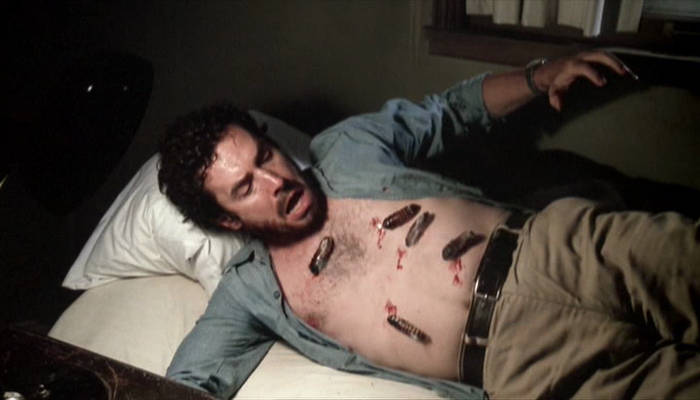
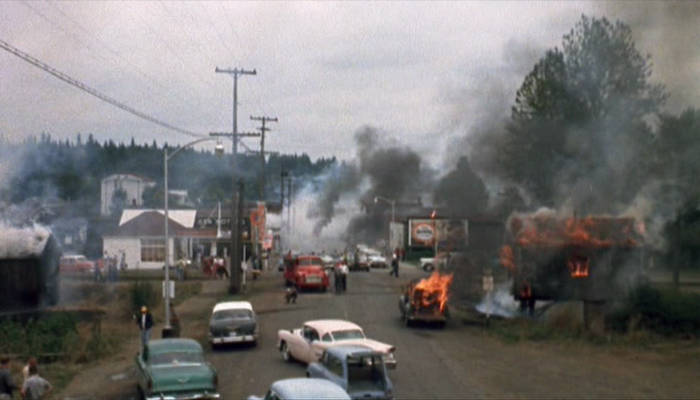
A powerful earthquake unleashes dozens of mutant cockroaches unlike anything science has ever before seen onto a small California town. Crawling from newly created fissures in the earth, the creatures possess incredible anatomical and physiological characteristics (“They have no digestive system, not even a stomach, and they’re full of some kind of bacteria that metabolizes the carbon“; “They’ve got the bends. The pressure’s slowly killing them […] they have no pressure bladder to relieve it, and the carapace is sealed airtight. They came from very deep in the earth, remember?“). But these creatures’ most alarming characteristic is their ability to start fire with their “rear antennas” (cerci).
When university biologist James Parmiter’s wife falls victim to a fire caused by the sulfurous creatures, the tragedy sends the professor off the deep end, and he holes up on a farm to obsessively study the deadly roaches.
His experiments to crossbreed these mutant “firebugs” with ordinary cockroaches produce a truly horrifying hybrid: a fire-starting, flesh-eating cockroach perfectly happy living on Earth’s surface. Oh, and it’s as intelligent as “Homo sapiens” – just what we needed!
Is there any kind of an insect that can make fire?
Critique
4.5William Castle’s final production – he was co-screenwriter as well – ends up being an unambitious sci-fi horror film whose main point of interest lies in its peculiar narrative style.
After a wide-ranging first half that pays homage to the environmentalist vein of sci-fi films so popular at the time (including nostalgic reflections such as: “communication: man used to have that gift, we’re told. He could talk to the Earth and all the creatures on it. Somewhere along the line, he lost the gift“), the second half turns claustrophobic, focusing on one man’s descent into madness as he increasingly assumes all the traits of a typical mad scientist.
Unfortunately, the end product disappoints on multiple fronts: for at least an hour, the 35-year-old Jeannot Szwarc fails to instill even that minimum degree of tension that the film’s context cries out for; Charles Fox’s soundtrack is basically just racket and annoying to the nth degree; Thomas Page’s screenplay – which makes a series of incomprehensible and ill-timed changes to the plot of his own novel (“The Hephaestus Plague” – 1973) – seems patchy, as well as incapable of conferring any psychological depth to the characters; beyond that, even the danger presented by the incendiary cockroaches seems to lose credibility once lifted from the pages of the novel and transposed into the visual medium.
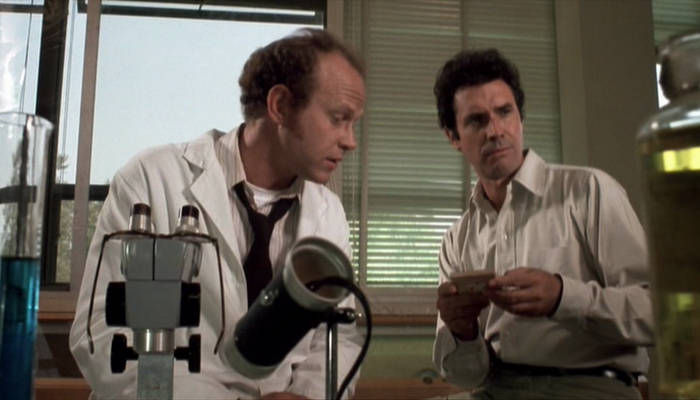
Finally, the numerous science-laden scenes rich with specialized jargon are plagued by equally numerous inaccuracies (for example, calling an exoskeleton a “carapace”) as well as outright mistakes (as in the case of the dialogue in which the biologist contradicts his former student regarding the fact that they’re dealing with a Blattodea and then states that it’s an insect).
A few decent effects and a Bradford Dillman entirely in his element as the obsessed professor aren’t enough to keep a mediocre and not very engaging movie afloat.
More Info
- Based on the novel "The Hephaestus Plague" (1973) by Thomas Page
Quotes
- The Parmiteras sense I'm the more powerful. They seem to know they'll live only as long as I allow them to.
- Is there any kind of an insect that can make fire?
Trivia
- Taxonomists have established international conventions for scientific nomenclature. For the animal kingdom, the binomial name consists of a genus name plus a specific epithet. Note that the designations are in Latin (making them globally consistent, with no need to translate them into countless languages). Numerous species bear the name of their discoverers (e.g., “Trioceros jacksonii”), a tradition that the protagonist here, being the good egocentric, doesn’t shy away from. Still, his plan to name the new species “Parmitera hephaestus” is incongruous from a taxonomic point of view because first, the man’s surname (Parmiter) should be used to identify the species, not the genus, and second, the Latin endings don’t make sense since the species should end in “-i” (rather than “-us”), since “Hephaestus” is a masculine noun belonging to the second declension, which takes the “-i” ending in the genitive case.
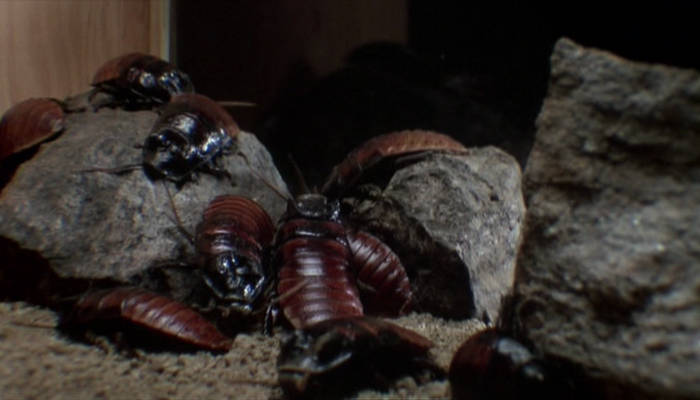
- For scenes depicting the lethal “Blatta” produced by Dr. Parmiter’s crossbreeding experiments, they filmed male specimens of “Gromphadorhina portentosa” (commonly known as the “Madagascar hissing cockroach).
- Weird fact: the room number of the pathology lab is “1408”, which also happens to be the title of Stephen King’s 2002 ghost story as well as the title of Mikael Håfström’s 2007 big-screen adaptation of that story.
Products
Disclosure
This page contains affiliate links. As an Amazon Associate I earn from qualifying purchases.
Image source: Amazon Partner Program
| Product name | Price | |
|---|---|---|
![Bug [DVD]](https://m.media-amazon.com/images/I/51xDWhqw-gL._SL75_.jpg) | Bug [DVD] | |
 | The Hephaestus Plague |
| Nome del prodotto | Prezzo | |
|---|---|---|
 | Bug |
| Product name | Price | |
|---|---|---|
| The Hephaestus Plague |
| Nombre del producto | Precio | |
|---|---|---|
| The Hephaestus Plague (English Edition) |
| Produktname | Preis | |
|---|---|---|
| The Hephaestus Plague (English Edition) |
| Nom du produit | Prix |
|---|
| Product name | Price | |
|---|---|---|
| Bug (1975) [Blu-ray] | |
| The Hephaestus Plague |