Plot
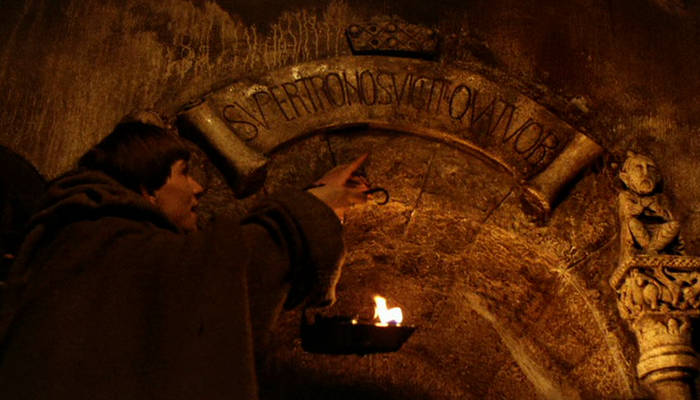
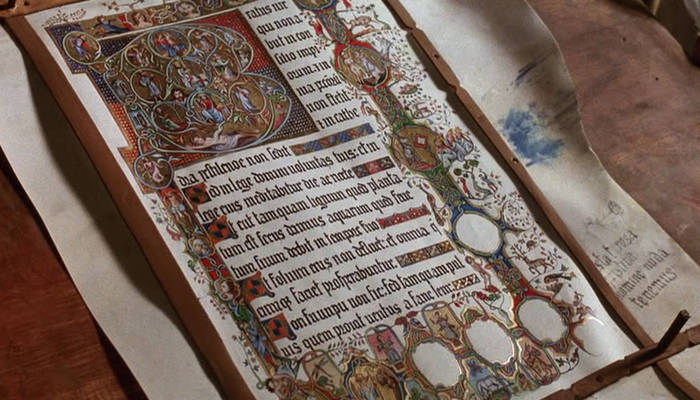
It’s the autumn of 1327, and Franciscan friar William of Baskerville, with young novice Adso of Melk in tow, arrives at an imposing Benedictine abbey in the snow-clad mountains somewhere in northern Italy. But an air of paranoia permeates this dank, claustrophobic locale after the suspicious death of a brilliant young manuscript illuminator named Adelmo leads several monks to fear that an evil, supernatural force is at work.
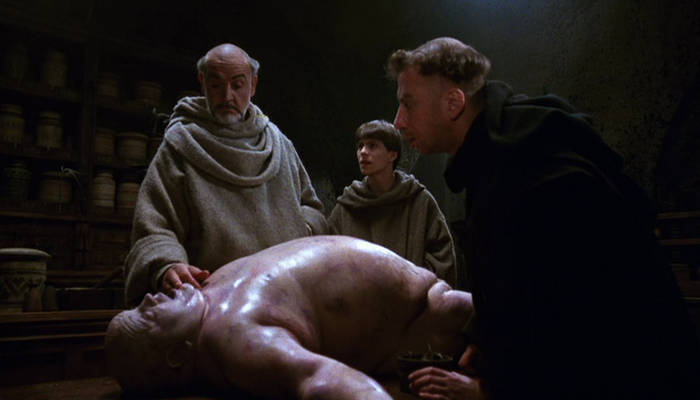
William, a former investigator for the Inquisition, accepts the challenge of uncovering the truth and promptly begins examining evidence and searching for clues. He concludes that Adelmo’s death was almost certainly a suicide, but barely has time to inform the abbot before a new body pops up – and this time there’s no doubt it was murder.
More determined than ever to ascertain the truth, William becomes convinced that the enigma revolves around a forbidden “book that kills” – a mysterious Greek tome which inevitably proves fatal to anyone who reads it. Complicating matters is the arrival of the Holy Inquisition in the person of Bernardo Gui, the less than reputable zealot who had imprisoned and tortured William in the past. Gui promptly discredits William’s theories, instead connecting every misdeed to three innocent individuals, accusing them of heresy and witchcraft and sentencing them to burn at the stake.
Meanwhile, the steady stream of unsettling deaths shows no sign of abating…
Laughter kills fear and without fear there can be no faith.
Critique
6.5Jean-Jacques Annaud paints the portrait of a Middle Ages steeped in the stereotypical (but not terribly authentic) gloom and filth that remain prevalent in our collective imagination of that dark era to this day.
That aside, as a purely entertaining mystery-thriller, Annaud’s film is a rousing success, both from a visual perspective (Tonino Delli Colli’s magnificent cinematography rich in warm tones, Dante Ferretti’s painstakingly accurate production design, the atmospheric interiors of Eberbach Abbey, etc.) as well as on the narrative front. A story filled with shadowy foreboding and horrific crimes pulls the spectator in almost from the very first frame, thanks to skillful pacing and a healthy dose of suspense.
In this atmosphere laden with superstition and metaphysical angst, William of Baskerville’s reassuring rationalism is the sole beacon of light. The superb Sean Connery plays the part with the right mix of acumen and irony: half philosopher and half scientist (following in the footsteps of Roger Bacon, and, generally, the Oxford Franciscan school), thirsty for knowledge and a noble connoisseur of the intellect (“We must not allow ourselves to be influenced by irrational rumors of the Antichrist. Let us instead exercise our brains and try to solve this tantalizing conundrum“). A sort of medieval Sherlock Holmes, he “enjoys” unraveling the tangled mystery through methodical work (systematically gathering clues, sifting through hypotheses, coming to measured conclusions) and putting his faith in the solidity of Aristotelian logic.
Bringing a story flowing from Umberto Eco’s pen to the big screen is certainly an ambitious endeavor. There’s always a strong urge to compare a film to its literary source, and in this case, it’s evident from the outset that the cultured philosophical and cultural framework that represented the heart and soul (as well as the most interesting aspect) of the over 500-page novel was inevitably stripped away. The resulting two-hour film represents an unavoidable impoverishment of the historical-conceptual dimension. First, numerous passages from the book were omitted or barely touched on (one example is the scant time devoted to the debate between the Franciscans and papal delegates regarding Christ’s poverty, a matter which, as a matter of historical record, culminated in a clash between the Avignon Pope John XXII and Michael of Cesena).
Beyond that, a series of distortions were introduced that are particularly hard to digest. Without a doubt, the biggest offender in this regard is the blatantly crowd-pleasing expedient of saving the peasant girl from being burned at the stake, and then turning her into the “raison d’être” for the film’s title (“She was the only earthly love of my life, yet I never knew nor ever learned her name“). In fact, although the rose was often used to symbolize female sexuality in allegorical Medieval literature (the well-known “Le Roman de la Rose”, circa 1230-80, for example), Eco tends to imbue the rose with much more subtle meanings (see the “trivia” section).
Honestly, all things considered, these choices are completely understandable, geared as they are towards making the finished product palatable to a mainstream public. Even so, in light of the overall quality of that finished product, we’re left with some regret for what could have been if only the creative minds had been a bit more daring when it came to the subject matter.
More Info
- Based on the novel "Il Nome della Rosa" (1980) by Umberto Eco
Quotes
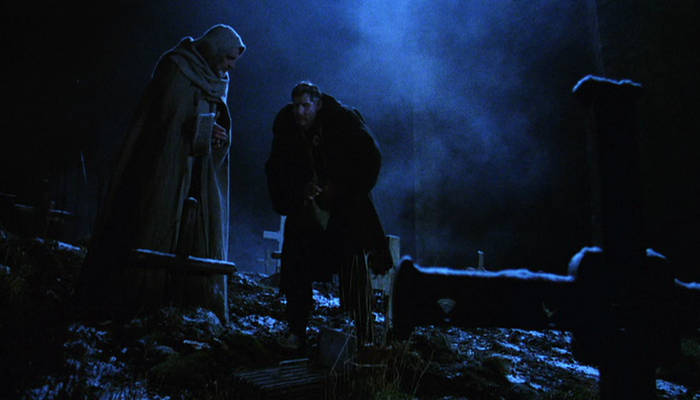
- We are very fortunate to have such snowy ground here. It is often the parchment on which the criminal unwittingly writes his autograph.
- Laughter kills fear and without fear there can be no faith. Because without fear of the devil, there is no more need of God.
- I am inspired by the devil! Adrammelech, Lucifer, I summon you, lords of hell! Alastor! Azazel!
- Fellow Franciscans, you must leave this place at once. The devil is roaming this abbey!
- She is already burnt flesh, Adso. Bernardo Gui has spoken. She is a witch.
- With the second trumpet the sea became blood, and behold, here is blood.
- I want to see the book in Greek that you said was never written.
Trivia
- The debate over universals represents the main philosophical diatribe of the twelfth century. Basically, the issue pertains to the ontological foundation of concepts and their relationship with extramental reality – a relationship with significant repercussions in linguistic, gnoseological, and theological fields. The “quaestio de universalibus” was raised by Porphyry of Tyre, a third-century Neoplatonic philosopher in his introduction (known as the “Isagoge”) to Aristotle’s “Categories”. A couple of centuries later, Roman senator and philosopher Boethius will be the first to tackle the subject again when he finds himself translating Porphyry’s work. Boethius’s comments ignited a heated debate in Medieval philosophical schools, and, in particular, in the realm of Scholasticism. Two diametrically opposed positions on the matter quickly arose: that of the realists (William of Champeaux, Anselm of Canterbury) who held that universals are valid realities independent of thought, and that of the vocalists (e.g., Roscellinus – sometimes improperly considered “nominalists”) for whom universals are relegated to the abstract realm of thought (“flatus vocis”). In this regard, the film’s title echoes a verse by twelfth-century Benedictine monk Bernard of Cluny which expresses a vocalist position in regard to the aforementioned debate: “Rosa pristina nomine stat, nomina nuda tenemus” = “The rose of old remains only in its name; we possess naked names”.
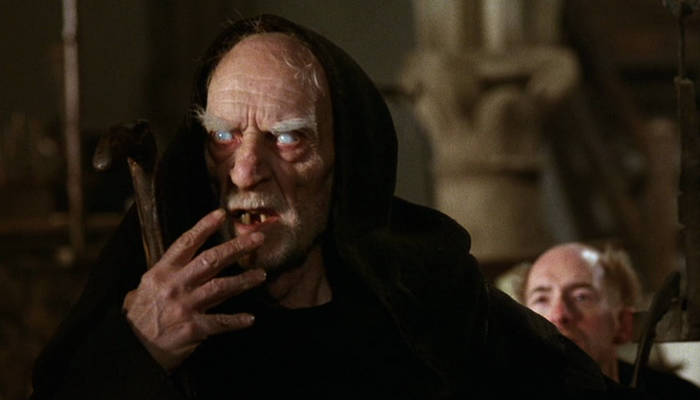
- The demented hunchback reveals his heretical past (he was a follower of Fra Dolcino of Novara) in a scene when he utters the corrupted cry “Penitenziagite” (a mangled “Poenitentiam agite” = “Repent” or “Do penance”). Historically, this expression is attributed to friar and theologian Salimbene of Parma (1221-c. 1290) in his “Chronicle” to Gerald Segarelli, millenarian preacher and founder of the Apostolic Brethren.
- Before the role of the hunchback was awarded to a then-unknown Ron Perlman (who gave an extraordinary performance, incidentally), some of the names flying around as potential actors to fill the role included Salvatore Baccaro (he was the well-endowed beast in Luigi Batzella’s “The Beast in Heat” and appeared in a thousand other trashy “Made in Italy” movies) and Franco Franchi.
- The scene where Dominican friar and papal inquisitor Bernardo Gui (c. 1261-1331) is fatally impaled is a product of the screenwriters’ imagination – the real historical figure died four years after the events of the movie, at Laroux castle.
Products
Disclosure
This page contains affiliate links. As an Amazon Associate I earn from qualifying purchases.
Image source: Amazon Partner Program
| Product name | Price | |
|---|---|---|
 | The Name Of The Rose | |
![The Name of the Rose [Blu-ray]](https://m.media-amazon.com/images/I/91UZWX0RsnL._SL75_.jpg) | The Name of the Rose [Blu-ray] | |
 | The Name of the Rose |
| Nome del prodotto | Prezzo | |
|---|---|---|
 | Il nome della rosa - Nuova edizione rimasterizzata in HD | |
 | Il nome della rosa. Ediz. illustrata |
| Product name | Price | |
|---|---|---|
 | The Name Of The Rose (1986) (Blu-ray) (Region 2) (Import) | |
 | The Name of the Rose (Vintage Classics) |
| Nombre del producto | Precio | |
|---|---|---|
![El Nombre De La Rosa - Edición Especial [DVD]](https://m.media-amazon.com/images/I/61jzaxgS3LL._SL75_.jpg) | El Nombre De La Rosa - Edición Especial [DVD] | |
 | El nombre de la rosa (Contemporánea) |
| Produktname | Preis | |
|---|---|---|
![Der Name der Rose [Blu-ray]](https://m.media-amazon.com/images/I/810YY-Pw2mL._SL75_.jpg) | Der Name der Rose [Blu-ray] | |
 | Der Name der Rose (DVD) | |
 | Der Name der Rose |
| Nom du produit | Prix | |
|---|---|---|
![Le Nom de la Rose [Version Restaurée] [Blu-ray]](https://m.media-amazon.com/images/I/81-0tg6UjjL._AC_SL75_.jpg) | Le Nom de la Rose [Version Restaurée] [Blu-ray] | |
![Le Nom de la Rose [Version remasterisée] [Edition remasterisée]](https://m.media-amazon.com/images/I/81CLU3UsZjL._AC_SL75_.jpg) | Le Nom de la Rose [Version remasterisée] [Edition remasterisée] | |
 | Le Nom de la rose |
| Product name | Price | |
|---|---|---|
 | Name Of The Rose | |
![The Name Of The Rose [Blu-ray]](https://m.media-amazon.com/images/I/71AnsazYLfL._AC_SL75_.jpg) | The Name Of The Rose [Blu-ray] | |
| The Name of the Rose |