

Plot
Max Renn, who runs a small, sleazy UHF TV channel specializing in softcore porn and violence, discovers a pirate satellite signal (“Videodrome”) which only broadcasts images of brutal torture and murder. Fascinated, he’s determined to track down the people behind the signal with an eye to exploiting this material on his own channel.
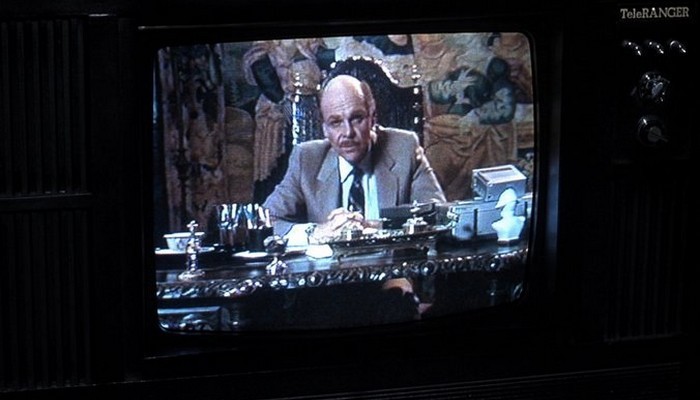
All roads seem to lead to Dr. Brian O’Blivion, guru of the ether, who maintains that television has taken on such great importance that it’s become the religion of the masses, which is why he’s communicated exclusively via video for over two decades.
Although not permitted to speak directly with the television prophet, Max obtains a videocassette of explicit content from the professor’s daughter. But watching the tape provokes intense headaches and excruciating hallucinatory episodes, marking the beginning of the unfortunate man’s psycho-philosophical collapse and irreparably jeopardizing his perception of reality.
Long live the new flesh.
Critique
10The Canadian director’s absolute masterpiece, “Videodrome” is the overarching metaphor through which he expresses his personal anxieties about the consequences contemporary society’s incessant media bombardment might have on viewers. His reflections are imbued with a deep-seated pessimism about the notion of mass media’s power and its ensuant mass depersonalization which eliminates any form of resistance (critical thought), granting it free reign to continue. On the other hand, Cronenberg, a big believer in the intrinsic mind-body link, is eager to stress how the socio-political desire to mold citizens’ minds and dull their brains leads to physiological as well as psychological changes.
The influence of the Toronto School of communication theory is evident in this regard, particularly the work of the forward-thinking Marshall McLuhan, who, in his most famous work “Understanding Media: The Extensions of Man” (1964), expressed it this way: “Once we have surrendered our senses and nervous systems to the private manipulation of those who would try to benefit from taking a lease on our eyes and ears and nerves, we don’t really have any rights left…”.
Bianca O’Blivion says this in the film: “The tone of the hallucinations is determined by the tone of the tape’s imagery. But the Videodrome signal, the one that does the damage, it can be delivered under a test pattern, anything“. Those words constitute an explicit reference to McLuhan’s famous assertion: “The medium is the message” which encapsulates the concept that “Independent of its content or messages, a medium has its own intrinsic effects on our perceptions which are its unique message”. This in turn speaks to the importance of examining mass media not so much based on the content it propagates, but rather by analyzing the structural criteria with which the communication is organized.
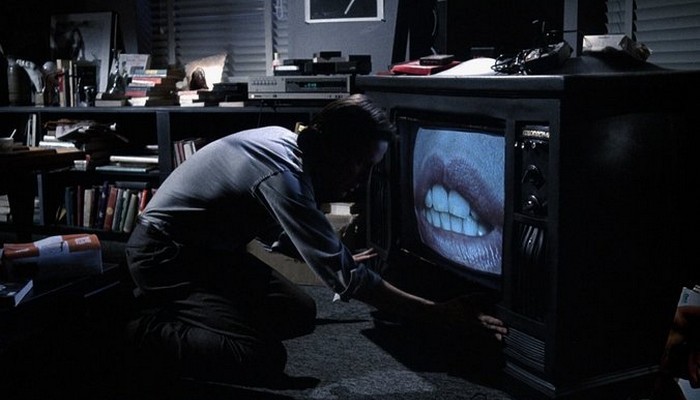
In fact, the Videodrome signal “will ultimately create a new outgrowth of the human brain“, which in turn will lead to the creation of a novel sort of individual (“new flesh”), one lacking individual willpower and easily programmed and reprogrammed. This final aspect is superbly rendered by Rick Baker’s unforgettable special effects which create a true role reversal, imbuing machines with human characteristics (Betamaxes that breathe and a TV set that vibrates, quivers with excitement, and bleeds) while reducing man to a mere mechanical accessory (the protagonist even transforms into a sort of video recorder).
There’s no lack of sarcastic vitriol sprinkled throughout the film, such as the TV-dependent assistance offered to homeless people inside The Cathode Ray Mission or the very thought of the CEO of a multinational corporation doing commercials for eyeglasses (apparently, vision care is important when you want people to spend a huge chunk of their time in front of the TV).
Superb cast: James Woods is perfect as Max Renn, a standoffish, Machiavellian individual destined to become a human guinea pig for something that goes far beyond his comprehension and his restricted utilitarian horizons. The stunning voice of radio host/psychiatrist Nicki Brand, umpteenth victim of the signal, belongs to Debbie Harry of “Blondie” fame.
If perfection in genre film exists, its name is “Videodrome”.
More Info
Quotes
- The television screen is the retina of the mind's eye. Therefore, the television screen is part of the physical structure of the brain. Therefore, whatever appears on the television screen emerges as raw experience for those who watch it. Therefore, television is reality and reality is less than television.
- I think we live in overstimulated times. We crave stimulation for its own sake. We gorge ourselves on it. We always want more, whether it's tactile, emotional or sexual... and I think that's bad.
- Long live the new flesh.
Trivia
- William Gibson’s classic cyberpunk novel “Virtual Light” (1993) describes a pseudo-Christian community founded by a certain Reverend Fallon who has chosen television as the supreme medium of salvation (not unlike the “Church of the Cathode Ray” in “Videodrome”). Ironically, a character in the novel gets banished from this community for showing his mother that very same David Cronenberg film, whose criticism of mass media has been deemed detrimental to Fallon’s teachings (“You know they’re saying I’m an apostate here? […] An apostate. ‘Cause I showed my mom this Cronenberg film, Berry? This Videodrome? And they said it was from the Devil.” […] “There’s movies that are clearly of the Devil, Berry. Or anyway that’s what Reverend Fallon says. Says all of Cronenberg’s are”).
- Many of the concepts expressed in Cronenberg’s “Videodrome” can be traced back to the writings of French philosopher and sociologist Jean Baudrillard.
Products
Disclosure
This page contains affiliate links. As an Amazon Associate I earn from qualifying purchases.
Image source: Amazon Partner Program
| Product name | Price | |
|---|---|---|
![Videodrome (The Criterion Collection) [Blu-ray]](https://m.media-amazon.com/images/I/41RGwoM8UxL._SL75_.jpg) | Videodrome (The Criterion Collection) [Blu-ray] | |
![Videodrome (The Criterion Collection) [DVD]](https://m.media-amazon.com/images/I/41I+qTPei3L._SL75_.jpg) | Videodrome (The Criterion Collection) [DVD] | |
 | Videodrome | |
 | Understanding Media: The Extensions of Man | |
 | Symbolic Exchange and Death (Published in association with Theory, Culture & Society) |
| Nome del prodotto | Prezzo | |
|---|---|---|
 | Videodrome | |
 | Gli strumenti del comunicare | |
 | Lo scambio simbolico e la morte |
| Product name | Price | |
|---|---|---|
| Videodrome | |
 | Understanding Media: (Routledge Classics): The Extension of Man | |
| Symbolic Exchange and Death (Published in association with Theory, Culture & Society) |
| Nombre del producto | Precio | |
|---|---|---|
![Videodrome [Blu-ray]](https://m.media-amazon.com/images/I/51FsY6hwCAL._SL75_.jpg) | Videodrome [Blu-ray] | |
![Videodrome [DVD]](https://m.media-amazon.com/images/I/51R3i07V-uL._SL75_.jpg) | Videodrome [DVD] |
| Produktname | Preis | |
|---|---|---|
 | Videodrome | |
| Understanding Media: (Routledge Classics): The exgtensions of man | |
 | Der symbolische Tausch und der Tod (Batterien) |
| Nom du produit | Prix | |
|---|---|---|
| Videodrome | |
| Videodrome [Blu-Ray] [Import] | |
 | Pour comprendre les médias | |
 | L'échange symbolique et la mort |
| Product name | Price | |
|---|---|---|
| Videodrome (Criterion) (Blu-Ray) | |
 | Videodrome 4K UHD/BLU-RAY | |
| Symbolic Exchange and Death | |
| Understanding Media: The Extensions of Man | |
| Understanding Media |