


Plot
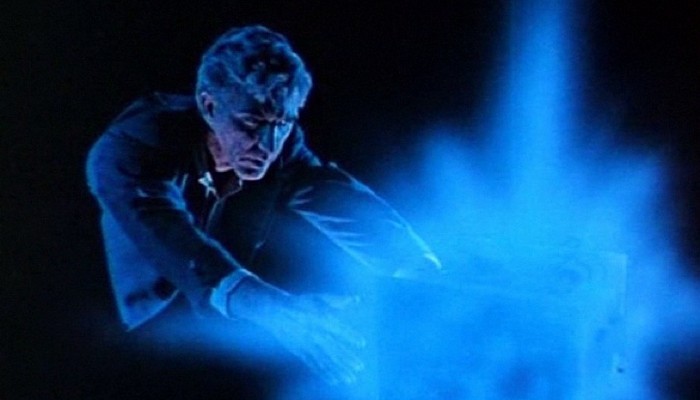
Brilliant scientist Tony Nelson has an incredible theory: He’s convinced he can build an electronic amplifier that would stimulate a solid object on the atomic level, accelerating it into the “4th dimension” and enabling it to safely pass through another solid object. Unfortunately, his inattention during a crucial experiment results in an electrical fire that destroys his lab.
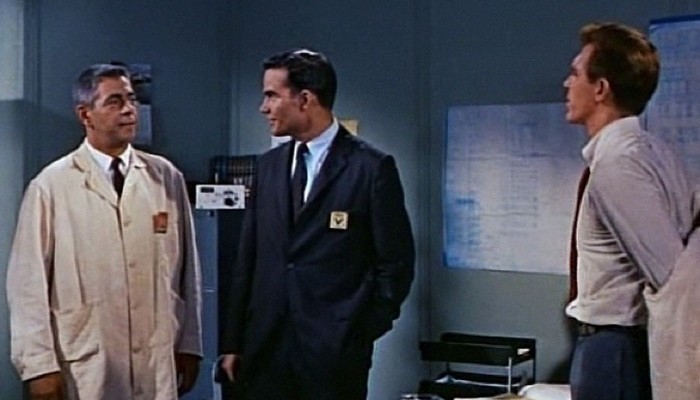
Finding himself unemployed, the irresponsible young genius hitchhikes to the cutting-edge research center where his older brother Scott, also a brilliant physicist, is an unappreciated workaholic in charge of developing a new, impregnable metal. Due to a history of disputes, the two brothers share a shaky relationship which takes yet another hit when Scott’s beautiful young assistant – who also happens to be the woman he secretly plans to marry – ends up falling hard for the confident and upbeat newcomer.
This ignites Scott’s simmering anger, frustration, and resentment – which had been building in large measure due to his callously exploitive and crassly unappreciative boss – and he flies into a fit of rage. Breaking into Tony’s locker, he steals his brother’s equipment, desperate to achieve scientific recognition. A vaguely defined brain anomaly (apparently caused by Scott’s history of radiation exposure) somehow enables him to push Tony’s experiment to shocking new limits, giving him the godlike power to take anything he wants. And what he wants is revenge on everyone he feels has wronged him.
But he’ll quickly discover that this seductive scientific breakthrough comes at a horrific price…
Two objects can occupy the same space at the same time under proper conditions.
Critique
5The director of “The Blob” (1958) returns to sci-fi, taking on a classic plot with a moralizing undercurrent (it’s a cautionary tale of the dangers of scientific knowledge falling into the hands of an egotistical individual with an axe to grind).
Once again, the moving force behind “4D Man” is producer and writer Jack H. Harris (he also had a hand in “Dinosaurs!”, 1960), and he’s certainly no champion of hard science fiction. That reality is particularly glaring here, given that any scientific explanations for this amazing process that allows one solid object (including even a human being, the titular “4D Man”) to pass through another are swiftly set aside in favor of concepts more in line with Arthur Schopenhauer’s philosophy than particle physics. In fact, the fundamental ingredient for the experiment’s success is nothing more than the subject’s mental determination! (“That’s the whole theory… to amplify the electrical impulses from the brain“).
The story gets off to a sluggish and muddled start, hampered by a romantic sub-plot that’s something of a downer, what with the childish games between Tony and Linda (the latter played by a twenty-something Lee Meriwether sporting a half pound of lipstick). After the first reel, the film starts to hit its stride, thanks in part to the introduction of the horror component which basically entails the protagonist’s transformation into something of a vampire that drains life force in a sci-fi equivalent of sucking blood.
Among noteworthy peculiarities, we’d cite the bizarre – and somewhat intrusive – jazz soundtrack by Ralph Carmichael along with the eye-catching opening credits reminiscent of certain neuropsychological tests used to assess an individual’s ability to perform an attentional shift (arrows briefly flash on screen, indicating where the upcoming credit or credits will appear). Michael Posner, a true authority in the field, certainly must have been pleased.
More Info
Quotes
- He's not a magician. He can't fly, he's not invisible. He's as real and as solid as you or I. The only thing is, he can walk through a wall and I can't.
- You just want to play around with your theories and make like some 16th-century alchemist.
- Two objects can occupy the same space at the same time under proper conditions.
- There may be side effects to this we don't know anything about.
- Don't you know I'm indestructible? I can go through anything!
Trivia
- This was Lee Meriwether’s big-screen acting debut after winning the 1955 Miss America pageant, but it wasn’t her only role as a scientist. Meriwether was cast as Dr. Ann MacGregor, an electrobiologist in charge of determining how much force and heat a time traveler could tolerate in the sci-fi TV series “The Time Tunnel” (1966-1967). In fact, despite making dozens of films in her long career, she is most well-known for her wide-ranging TV appearances in everything from “Star Trek” (1969) to “CHiPs” (1979-1980) to “Desperate Housewives” (2012) – well over 80 different television series in all over seven decades, including 178 episodes of “Barnaby Jones” (1973-1980). One of her most memorable film roles was as The Catwoman in “Batman” (1966), the first full-length theatrical adaptation of the DC Comics character.
Products
Disclosure
This page contains affiliate links. As an Amazon Associate I earn from qualifying purchases.
Image source: Amazon Partner Program
| Product name | Price | |
|---|---|---|
 | 4D Man | |
 | 4D Man | |
 | Cognitive Neuroscience of Attention |
| Nome del prodotto | Prezzo | |
|---|---|---|
 | Piccola enciclopedia degli ultracorpi: I B-movies americani degli anni Cinquanta: Vol. 1 | |
 | Delitto In Quarta Dimensione / 4D Man |
| Product name | Price | |
|---|---|---|
 | 4d Man | |
![4d Man [DVD] [1959] [US Import] [NTSC]](https://m.media-amazon.com/images/I/91ugY3SW2kL._AC_SL75_.jpg) | 4d Man [DVD] [1959] [US Import] [NTSC] | |
| Cognitive Neuroscience of Attention, Second Edition |
| Nombre del producto | Precio | |
|---|---|---|
![4D Man [USA] [Blu-ray]](https://m.media-amazon.com/images/I/81aucsPQKFL._SL75_.jpg) | 4D Man [USA] [Blu-ray] |
| Produktname | Preis | |
|---|---|---|
![Der 4D Mann [Limited Edition]](https://m.media-amazon.com/images/I/51zAkiMriOL.jpg) | Der 4D Mann [Limited Edition] |
| Nom du produit | Prix | |
|---|---|---|
![4D Man [Blu-Ray]](https://m.media-amazon.com/images/I/81aucsPQKFL._AC_SL75_.jpg) | 4D Man [Blu-Ray] |
| Product name | Price | |
|---|---|---|
| 4D Man (Special Edition) | |
| 4D Man | |
| Cognitive Neuroscience of Attention |