Plot
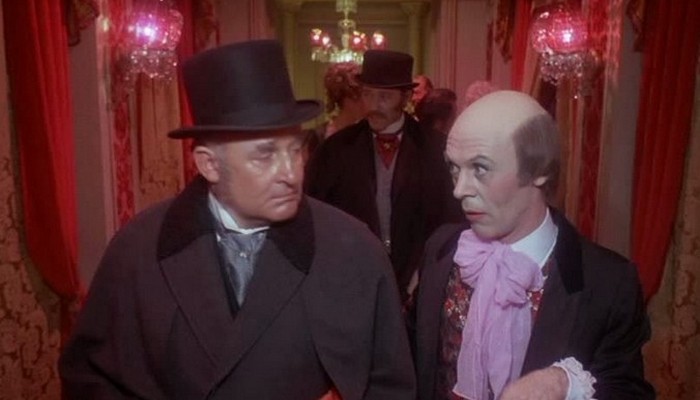
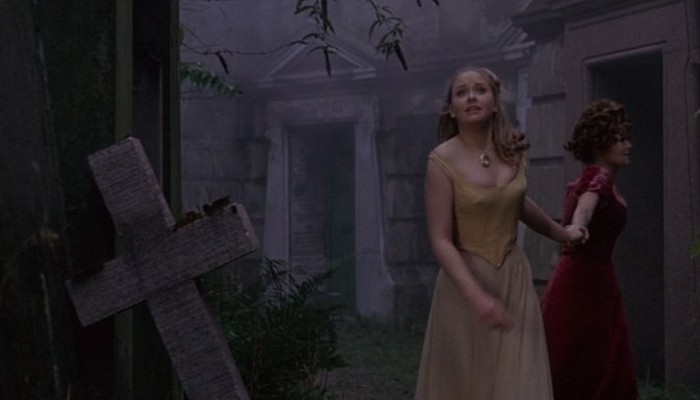
A trio of distinguished, middle-aged English gentlemen use a façade of sanctimonious righteousness to hide a licentious streak they unleash during nocturnal soirées – in a secret brothel hidden within a soup kitchen, no less! The sordid hypocrites find themselves in over their heads when their craving for new, more intense pleasures regrettably leads them to enlist the aid of diabolical necromancer Lord Courtley, who proposes a black mass as the solution to their desires.
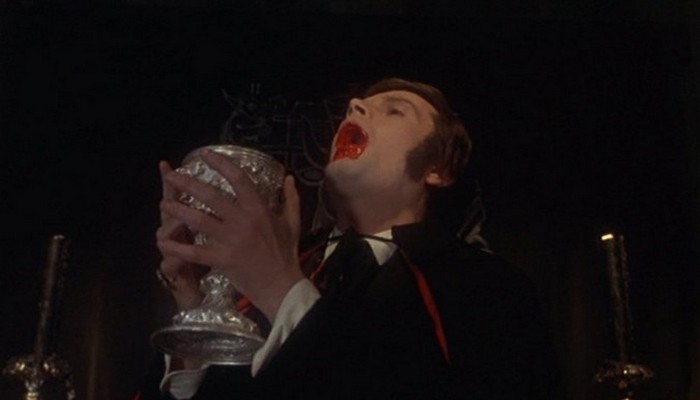
Courtley persuades them to purchase some relics, including dried blood (“A concentration of evil, my dear sirs“), from an unsavory merchant. These items just happen to be the remains of the most famous vampire of all time, and when the four assemble beneath the vault of a desanctified church to use them to perform a satanic blood ritual, things don’t exactly go as planned, and in a sudden frenzy of terror, the depraved trio kill Courtley and flee the church.
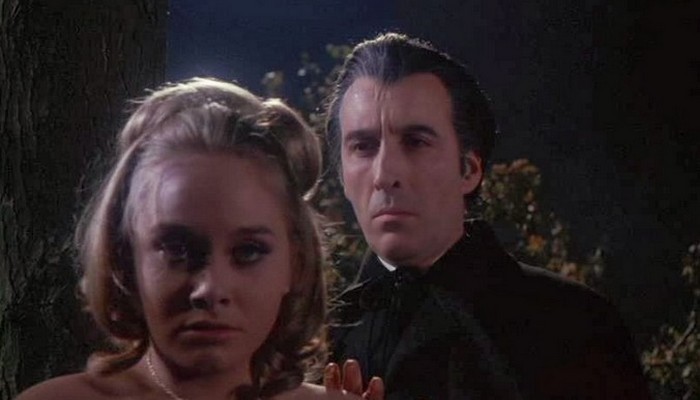
But Courtley’s plot to restore the evil count hasn’t failed after all – his lifeless body transforms into Dracula. The newly resurrected vampire vows his revenge on the men who destroyed his loyal acolyte, and he’ll employ particularly cruel methods to achieve that vengeance…
In the most august dread of the supreme Prince of Darkness [...], draw near and do my bidding, I command!
Critique
6.5The “Pop Dracula” experiment having run its course in 1968, Hammer – in collaboration with Warner Bros. – wisely decides to go a different route, and for the fifth entry in their franchise featuring the most well-known vampire in all history, they turn to the 34-year-old Peter Sasdy, with numerous TV episodes under his directing belt.
It was a daring choice, but at the end of the day it turned out to be a winning play, given that “Taste the Blood of Dracula” emerges as one of the best films of the entire series. Esthetically refined and rich with evocative ideas that accentuate an underlying technical know-how, this is a work of suffocating darkness which rises from the merely esthetic plane to directly incorporate an allegorical-moralistic component. After all, the very idea of the count’s return (he’s always been a metaphor for Evil) being prompted by the unbridled boredom of three dismal, bourgeois representatives of their era (“And having tried everything that your narrow imaginations can suggest, you’re bored to death with it all, right? And now you want someone with infinitely greater experience than yourselves to suggest alternatives?“), serves to highlight that all-too-common impulsiveness and poor judgement that formed the basis of the “banality of evil” concept that political theorist and philosopher Hannah Arendt elaborated in her 1963 book “Eichmann in Jerusalem: A Report on the Banality of Evil”.
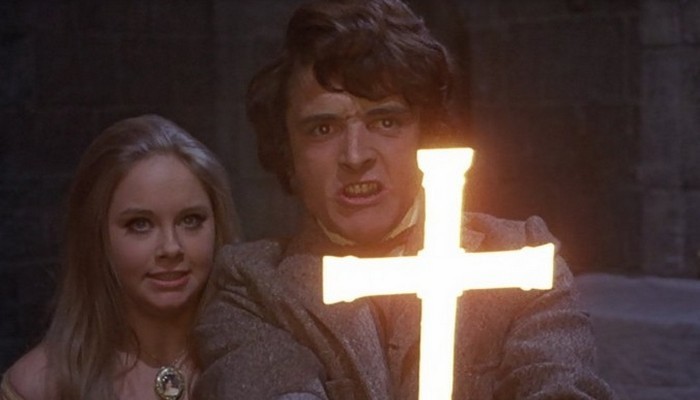
Further, the choice to ruthlessly linger on the recently ended Victorian era’s characteristic hypocrisy and its consequences not only takes on a menacing symbolism (with the offspring committing patricide almost as if attempting to sever the final bonds tying them to that false, dissimulating Victorian generation), but also manages to echo current events – audiences of the time must not have found it difficult to grasp, in a more or less conscious way, the parallels with civil rights movements of the 1960s.
With that in mind, it’s clear how the figure of the count serves solely as a catalyst – his arrival is the fuse that ignites the sedate social expectations of a contradiction-filled reality, leading to an explosion of social revolution, which is why this iteration of the classic character might arouse some puzzlement among vampirism philologists. After all, we’re talking about a Dracula who’s interested in revenge rather than blood (“They have destroyed my servant. They will be destroyed!“). This oddity can be partially explained by Lee’s initial refusal to don the iconic cloak for this movie, leading to the development of a script which would have featured Ralph Bates’s Lord Courtley as the main villain.
Contractual obligations and some pleading by producer Michael Carreras ended up convincing the reluctant Lee to reconsider, and after a bit of short-lived drama (along the lines of “I hope this will be my final film for Hammer”), we’ll find Lee right back in the role for the following “Scars of Dracula” (1970) as well.
More Info
- Inspired by a character created by Bram Stoker
Quotes
- Hark, ye, oh ye timeless ones, ye elementals of the earth, and of the air, and of fire, and of water. In the most august dread of the supreme Prince of Darkness and of his archangels, and angels of darkness, and his legions, draw near and do my bidding, I command!
- You and your two friends here have formed a little society with the objects of enjoying the more unusual aspects of this life [...] at the same time, keeping up a façade of respectability in front of your families and local community.
Trivia
- The film was released to theaters in a double bill with Alan Gibson’s thriller “Crescendo” (1970).
Products
Disclosure
This page contains affiliate links. As an Amazon Associate I earn from qualifying purchases.
Image source: Amazon Partner Program
| Product name | Price | |
|---|---|---|
 | Dracula (Penguin Classics) | |
 | The Art of Hammer: Posters From the Archive of Hammer Films | |
 | Hammer Films: An Exhaustive Filmography | |
 | Taste the Blood of Dracula (Blu-ray) | |
 | 4 Film Favorites: Draculas (Dracula A.D. 1972, Dracula Has Risen from the Grave, Horror of Dracula, Taste the Blood of Dracula) |
| Nome del prodotto | Prezzo | |
|---|---|---|
 | Dracula | |
 | A qualcuno piace l'horror. Il cinema della Hammer Films: 1 | |
 | Una Messa Per Dracula (Restaurato In Hd) |
| Product name | Price | |
|---|---|---|
| Dracula: Stoker Bram (Penguin Classics) | |
 | Dracula (Deluxe Hardbound Edition) | |
| Hammer Films: An Exhaustive Filmography | |
| The Art of Hammer - Posters from the Archive of Hammer Films (Updated Edition) | |
| Taste the Blood of Dracula |
| Nombre del producto | Precio | |
|---|---|---|
 | Drácula (Austral Singular) | |
![El poder de la sangre de Drácula [DVD]](https://m.media-amazon.com/images/I/51oTDiyMwpL._SL75_.jpg) | El poder de la sangre de Drácula [DVD] |
| Produktname | Preis | |
|---|---|---|
 | Dracula. Ein Vampirroman | |
 | Dracula. Ein Vampirroman: Vorlage für den Horrorfilm „Nosferatu – Der Untote“. Bram Stokers legendärer Schauerroman, klassisch in Cabra-Leder gebunden mit Silberprägung (Cabra-Leder-Reihe, Band 20) | |
![Wie schmeckt das Blut von Dracula [Blu-ray]](https://m.media-amazon.com/images/I/51cLNcNZcRL._SL75_.jpg) | Wie schmeckt das Blut von Dracula [Blu-ray] | |
![Dracula Triple Blood Edition: Draculas Rückkehr / Wie schmeckt das Blut von Dracula / Dracula jagt Mini-Mädchen [Blu-ray]](https://m.media-amazon.com/images/I/51Ef1w49BuL._SL75_.jpg) | Dracula Triple Blood Edition: Draculas Rückkehr / Wie schmeckt das Blut von Dracula / Dracula jagt Mini-Mädchen [Blu-ray] |
| Nom du produit | Prix | |
|---|---|---|
 | Dracula | |
 | Dracula | |
![Une Messe pour Dracula [Blu-Ray]](https://m.media-amazon.com/images/I/51Ba87oTStS._SL75_.jpg) | Une Messe pour Dracula [Blu-Ray] |
| Product name | Price | |
|---|---|---|
| Dracula (Deluxe Hardbound Edition) | |
 | Dracula | |
| The Art of Hammer: Posters From the Archive of Hammer Films | |
| Taste the Blood of Dracula [Blu-ray] [Import] | |
| 4 Film Favorites: Draculas |