Plot
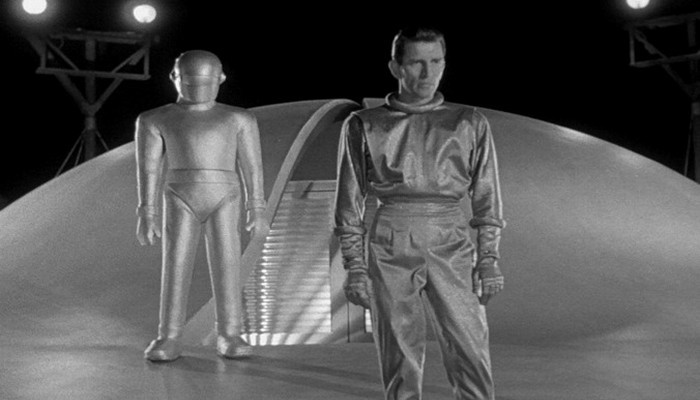
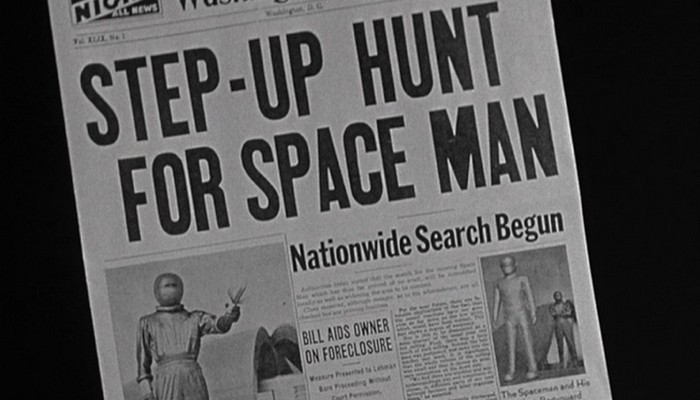
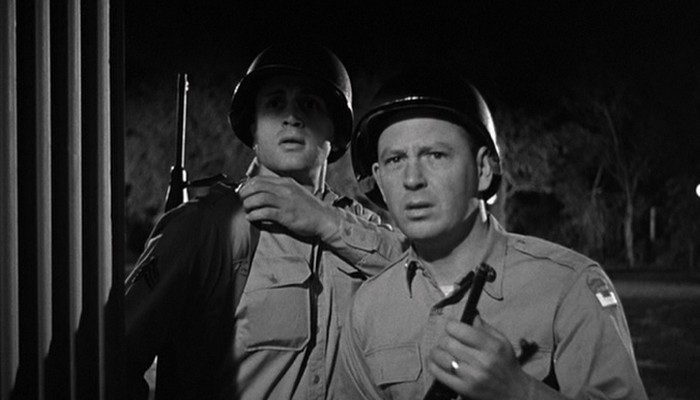
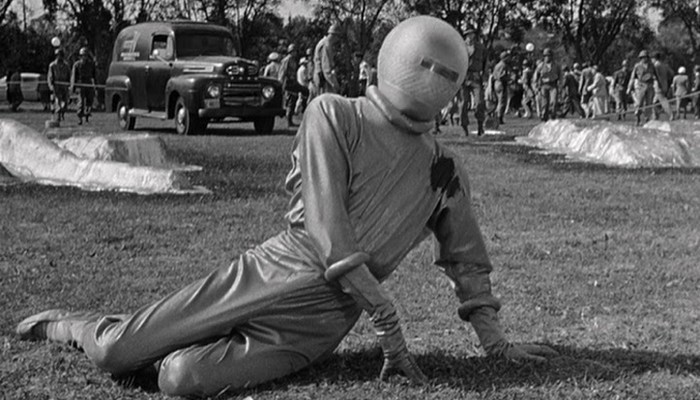
Washington, D.C.: a flying saucer appears in the sky and settles on the grassy mantle of a park, much to the public’s general amazement and curiosity. The Army swiftly takes control, cordoning the area off with armored vehicles and men in battle gear. The spacecraft initially shows no signs of life, heightening the climate of anxious anticipation that has arisen amongst the bystanders. Suddenly a humanoid figure emerges from a bay of the craft, carrying a strange device that is mistakenly assumed to be threatening. Inevitably, a jittery soldier responds violently, shooting the alien.
A massive robot intervenes to defend the mysterious visitor, disintegrating the soldiers’ weapons with laser beams. After the wounded alien, who calls himself Klaatu and can speak any language, delivers a brief explanation, the situation de-escalates and the alien is taken to Walter Reed Hospital to receive necessary care.
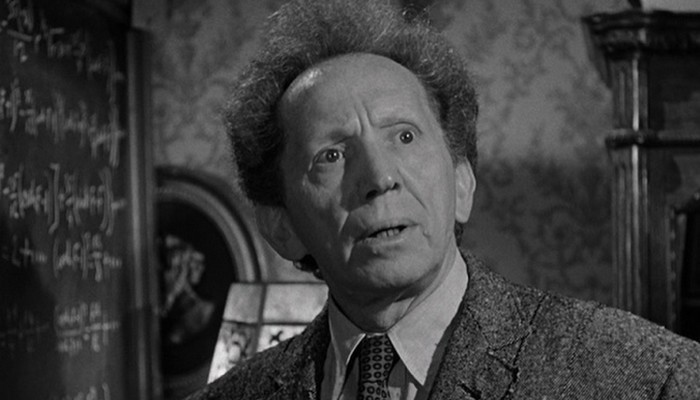
Escaping from the medical center, Klaatu eventually contacts Jacob Barnhardt, an elderly physics professor, and confides in him the true motive for his visit to Earth: to warn the nations of the earth to cease any and all military activities, given that with the advent of the atomic age, humanity is capable of unleashing enough firepower to represent a serious danger, even to other planets. His message represents an honest-to-goodness ultimatum from the Galactic Confederation, a mysterious body in charge of maintaining peace in the universe (“Your choice is simple: join us and live in peace, or pursue your present course and face obliteration. We shall be waiting for your answer“.
Klaatu barada nikto!
Critique
8The years between the late 1930s and late 1940s have been dubbed the “Golden Age of Science Fiction” in America, a historical period characterized by prolific literary output by top-level authors (Isaac Asimov, Arthur C. Clark, Robert A. Heinlein, Alfred E. van Vogt, etc.) who skillfully employed the genre to convey the worries, anxieties, and hopes of the time. Profoundly influenced by the Golden Age, movie studios quickly released an unprecedented number of sci-fi films in the 1950s, a good number of which are marked by what has been justly defined as “Cold War hysteria”.
Basically, moviegoers got plots driven by a climate of anxiety and alarmism, in which an outsider (usually an alien) tends to symbolize the Soviet enemy, or, more generally, the communist menace (“Red Scare”). Against this backdrop of paranoia and suspicion, “The Day the Earth Stood Still” is truly a rare breed. Drawing inspiration from Harry Bates’s short story “Farewell to the Master” (1940), the director levels a bitter criticism of mankind’s imprudent conduct by taking aim at governments around the world and their perennial tendency towards conflict.
From this point of view, the alien Klaatu represents the embodiment of level-headedness and a capacity for good judgement, which is why his visit manages to inject ethics and accountability in addition to serving as a warning that we must undertake a course of cooperation and solidarity or face our destruction.
Never having been one for dramatic showmanship, Wise treats his pet concepts with restrained elegance. Additionally, the intelligent dialogue, Leo Tover’s refined B/W cinematography, and Michael Rennie’s unforgettable performance as the extraterrestrial are elements that further enhance what is, for all intents and purposes, an essential classic in the history of cinema (it was no surprise that this film was among the first titles selected for preservation in the US Library of Congress National Film Registry).
A remake – that no one asked for or wanted – was released in 2008.
More Info
- Inspired by the novel "Farewell to the Master" (1940) by Harry Bates
Quotes
- Violent action [...] seems to be the only thing your people understand.
- Klaatu barada nikto!
Products
Disclosure
This page contains affiliate links. As an Amazon Associate I earn from qualifying purchases.
Image source: Amazon Partner Program
| Product name | Price | |
|---|---|---|
![The Day the Earth Stood Still [Special Feature, DVD]](https://m.media-amazon.com/images/I/41gXyzKQX0L._SL75_.jpg) | The Day the Earth Stood Still [Special Feature, DVD] | |
![The Day the Earth Stood Still (Special Edition) [Blu-ray]](https://m.media-amazon.com/images/I/51vbdGHqmZL._SL75_.jpg) | The Day the Earth Stood Still (Special Edition) [Blu-ray] | |
![The Day The Earth Stood Still (1951) [blu ray]](https://m.media-amazon.com/images/I/41kT7QDGXaL._SL75_.jpg) | The Day The Earth Stood Still (1951) [blu ray] | |
 | Farewell to the Master (Annotated) |
| Nome del prodotto | Prezzo | |
|---|---|---|
 | Ultimatum Alla Terra (Restaurato In Hd) (Spec.Edit.) |
| Product name | Price | |
|---|---|---|
![The Day the Earth Stood Still [DVD] [1951]](https://m.media-amazon.com/images/I/41Ub-SYKbfL._SL75_.jpg) | The Day the Earth Stood Still [DVD] [1951] | |
![The Day The Earth Stood Still [Blu-ray] [1951]](https://m.media-amazon.com/images/I/418dmGCzA6L._SL75_.jpg) | The Day The Earth Stood Still [Blu-ray] [1951] |
| Nombre del producto | Precio | |
|---|---|---|
 | Ultimatum a la Tierra (The Day the Earth Stood Still) (1951) (Robert Wise) (Blu-ray) | |
 | Ultimátum a la Tierra - Edición Especial |
| Produktname | Preis | |
|---|---|---|
| Day Earth Stood Still-Studio Class DVD [UK Import] | |
| Day The Earth Stood Still, The [Blu-ray] [UK Import] |
| Nom du produit | Prix | |
|---|---|---|
 | Le Jour où la Terre s'arrêta |
| Product name | Price | |
|---|---|---|
 | NEW Day The Earth Stood Still (DVD) | |
 | The Day the Earth Stood Still (Bilingual) |