A glimpse into the world of cinematic horror and sci-fi.
Robot
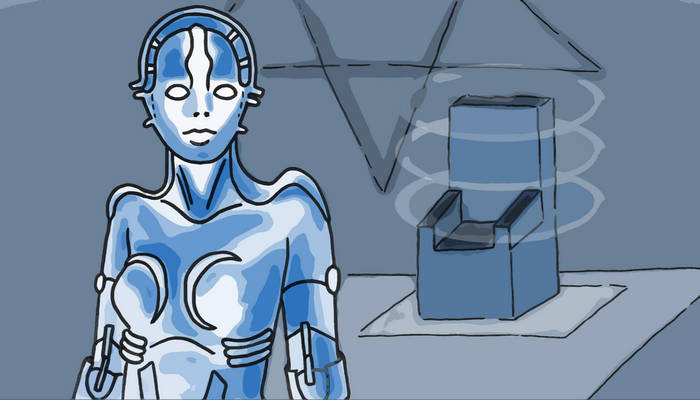
- androids: robots with a decidedly human appearance;
- cyborgs: hybrids representing a mix of biological and synthetic parts;
- futuristic computers: constructs with amazing characteristics and abilities.
Although the concept of artificial beings has fascinated people since the dawn of time (consider the golem of Jewish folklore, for example), it was only with the advent of the 20th century that such themes assumed a new and more alarming significance. In fact, the whirlwind pace of development in fields such as electronics and information technology inspired writers in the nascent sci-fi genre to offer novel reflections on the subject. One commonly expressed conjecture is that scientific advancement would lead to ever more complex and sophisticated artificial beings, plausibly resulting in the rise of self-awareness. Consequently, starting in the 1940s, the main ingredients in robot-centered fiction included speculations on their potential capabilities, along with a healthy dose of apprehension and ethical doubts. Such stories marked the birth of a flourishing sub-genre focusing on "the rise of the machines", a scenario in which self-aware mechanical entities get the upper hand over humanity, despite the reassuring laws of robotics devised by Isaac Asimov (as an example in the literary realm, we would cite "I Have No Mouth, and I Must Scream", the harrowing 1967 short story by Harlan Ellison which has also inspired a noteworthy video game).
Cinema quickly followed suit, with the ranks of mutinous machines rapidly expanding to include: HAL 9000, Colossus, The Delos Gunslinger, Proteus IV, the Nexus-6 replicants, a biocomputer built by Rising Sun Electronics, Joshua, and Skynet (+). Particularly noteworthy are those situations when the AI's anti-human hostility turns out to be the handiwork of its human creators. For example, the driving force behind android Ash endangering the human crew of the "Nostromo" was a secret order from the scheming Weyland Corporation ("Alien" - 1979). Likewise, rogue cyborg Hector's violent, unstable nature was caused by his neural connection to the psychopathic Captain Benson ("Saturn 3" - 1980). And who could forget the M.A.R.K. 13 from "Hardware" (1990), a biomechanical lifeform that was originally programmed to kill as part of a government plot to address the planet's severe overpopulation.
During the course of the new millennium, the theme of artificial intelligence - along with the relationship between man and machine - has been treated with greater maturity and awareness, delving into social and existential questions of extreme interest.
Examples
- Cinema/Television: "Metropolis" (Fritz Lang, 1927), "Electric Dreams" (Steve Barron, 1984), "Automata" (Gabe Ibáñez, 2014).
- Literature (fiction): "I, Robot" (Isaac Asimov, 1950), "Stand on Zanzibar" (John Brunner, 1968), "Neuromancer" (William Gibson, 1984).
- Videogames: "System Shock" (1994), "Machinarium" (2009), "Detroit: Become Human" (2018).
The table below includes only the films we’ve already reviewed, filtered by the current Tag. We know many important titles are still missing: they’ll come in time. Some features are reserved for our Patreon supporters.
| Title | Directors | Year | Score |
|---|---|---|---|
| Alien: Resurrection | Jean-Pierre Jeunet | 1997 | 6.5 |
| Alphaville | Jean-Luc Godard | 1965 | 7 |
| Arabian Adventure | Kevin Connor | 1979 | 4 |
| Dark Star | John Carpenter | 1974 | 5 |
| Dead Space | Fred Gallo | 1991 | 4 |
| Deadly Friend | Wes Craven | 1986 | 6 |
| Demon Seed | Donald Cammell | 1977 | 7 |
| Forbidden Planet | Fred M. Wilcox | 1956 | 9 |
| Forbidden World | Allan Holzman | 1982 | 6 |
| Fortress | Stuart Gordon | 1992 | 4.5 |
| Frankenstein's Army | Richard Raaphorst | 2013 | 6 |
| Futureworld | Richard T. Heffron | 1976 | 4.5 |
| Hardware | Richard Stanley | 1990 | 6.5 |
| I, Robot | Alex Proyas | 2004 | 3 |
| Kronos | Kurt Neumann | 1957 | 4.5 |
| Planet of Storms | Pavel Klushantsev | 1962 | 4 |
| Planets Around Us | Romano Ferrara | 1962 | 5.5 |
| Runaway | Michael Crichton | 1984 | 5 |
| Scream and Scream Again | Gordon Hessler | 1970 | 4.5 |
| Screams of Blasphemy | Shozin Fukui | 1991 | 4 |
| Silent Running | Douglas Trumbull | 1972 | 6 |
| Slave Girls from Beyond Infinity | Ken Dixon | 1987 | 4.5 |
| Slipstream | Steven Lisberger | 1989 | 5 |
| Solar Crisis | Alan Smithee, Richard C. Sarafian | 1990 | 4.5 |
| Supernova | Jack Sholder, Walter Hill | 2000 | 5.5 |
| Terminator 2: Judgment Day | James Cameron | 1991 | 8 |
| The Day the Earth Stood Still | Robert Wise | 1951 | 8 |
| The Matrix | Lana Wachowski, Lilly Wachowski | 1999 | 6.5 |
| The Terminal Man | Mike Hodges | 1974 | 6.5 |