Plot
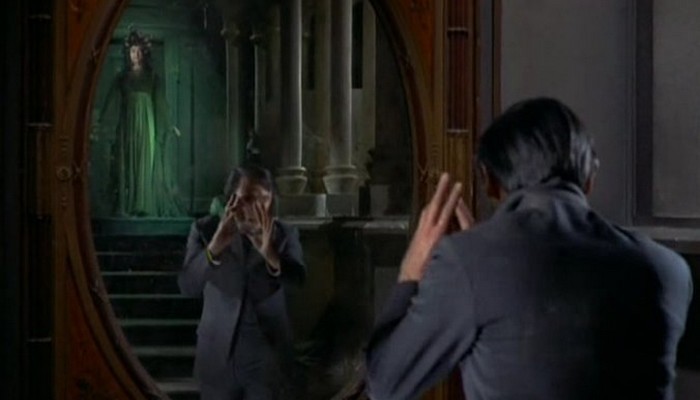
Set in the early 20th century, the spirit of Magaera, a horrific, mythological snake-haired Gorgon who turns to stone anyone who looks her in the face, is terrorizing a remote Black Forest village, literally petrifying hapless residents during nights with a full moon.
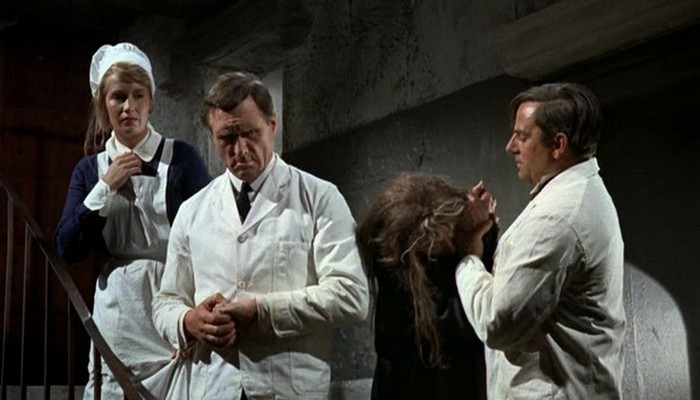
Joining in the village’s murky conspiracy of silence, the enigmatic Dr. Namaroff tries to explain away the mysterious deaths, despite being the only one to have guessed the uncomfortable truth behind the terrifying events.
The appearance of some outsiders determined to get to the bottom of the violent death of a young artist and relative will have explosive repercussions on the local community.
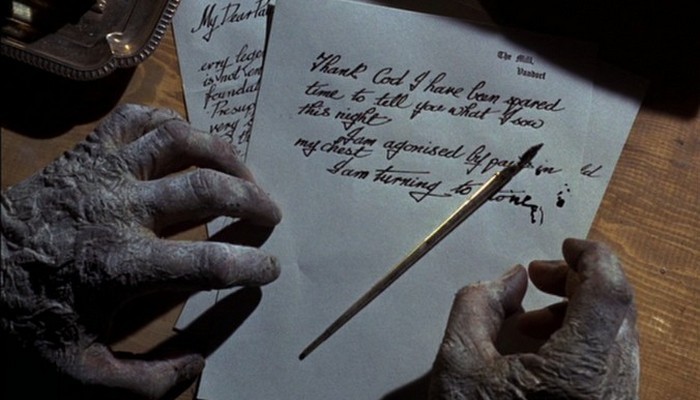
I am agonized by pains in my chest... I am turning to stone.
Critique
6.5Directed by veteran Terence Fisher based on an intriguing screenplay by the capable John Gilling, a gloomy Gothic loaded with ambience in which Val Lewton’s concept regarding the ineffability of reality and the mysterious forces that would disrupt it finds fertile ground in the mythologem of the power of sight (an element that led some critics to interpret the plot as a sort of allegory of scopophilia).
Although budgetary constraints negatively impact the quality of makeup and special effects, they doesn’t compromise the film’s ability to delve into the characters’ psychological dimension, thereby allowing the director to flesh out insights that are anything but banal regarding the good/evil dichotomy, the intricate nature of human beings, and the relationship between cognition and emotion.
In particular, the film analyzes the belief that silence, through an act of restraining negative emotion (“To the people of Vandorf, this thing, whatever it is, is real, but something they cannot mention because they dare not. They want to believe that it doesn’t exist, because the very admission of its existence only increases their fear“), can represent an effective means of exerting a measure of control over the horrors generated by reality. It’s no accident that similar arguments are reflected in the writings of influential authors of the recent past (ranging from the aphorisms of Giacomo Leopardi: “Men do not so much hate an evil-doer, or evil itself, as they hate the man who calls evil by its real name” to the psychoanalytic defense mechanisms identified by Sigmund Freud), whose common denominator lies in having contributed to dismantling the Enlightenment conception of man as a purely rational being.
Moreover, it becomes increasingly obvious how these very events occurring in the world reject the restrictions of a logico-scientific framework, and in the battle between metaphysics and science, the latter stumbles and falls despite the film teeming with brilliant minds eager to recast in reassuring terms a body of evidence that’s disquieting, to say the least. Even Herbert Spencer, prominent exponent of Anglo-Saxon positivism, is cited in the film: “Herbert Spencer once said that every legend and myth known to mankind is not without its authentic foundation“.
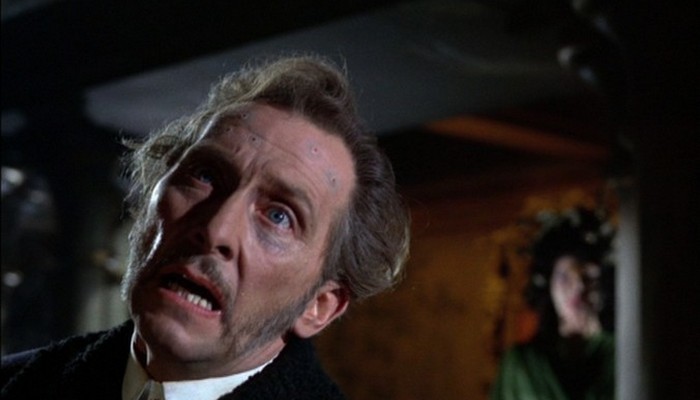
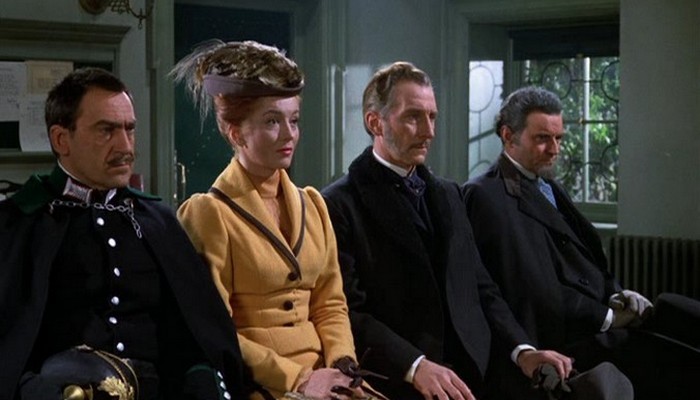
Turning to the cast, Peter Cushing turns in an excellent performance with a novel look (modest moustache and well-trimmed mutton chops) in the role of a decidedly unpleasant character, and for once, Christopher Lee (with a gray, Sam Elliot-style moustache) gets to play the “good guy”. Too bad we have to wait a month of Sundays before finally getting to see these two greats of cinematic horror square off.
Technicolor cinematography by Michael Reed. Produced by Hammer Films of London.
More Info
Quotes
- There have been seven murders committed in the forest of Vandorf in the past five years. Every victim bore the same marks, each body turned to stone!
- He tries to deny the existence of something he cannot explain. Megaera is... inexplicable and terrifying.
- I am agonized by pains in my chest... I am turning to stone.
- No one has seen her and lived.
Trivia
- Contrary to Professor Heitz’s claims, in Greek Mythology, Megaera and Tisiphone aren’t Medusa’s sisters, but rather (along with Alecto) the three Erinyes (aka “Furies”), spiteful personifications of vengeance. The three Gorgon sisters with hair of living snakes and horrifying visages that turned those who beheld them to stone were in fact Medusa (the only mortal of the trio), Stheno, and Euryale.
Products
Disclosure
This page contains affiliate links. As an Amazon Associate I earn from qualifying purchases.
Image source: Amazon Partner Program
| Product name | Price | |
|---|---|---|
 | The Art of Hammer: Posters From the Archive of Hammer Films | |
 | The Gorgon | |
 | Hammer Films Double Feature: The Two Faces of Dr. Jekyll / The Gorgon |
| Nome del prodotto | Prezzo | |
|---|---|---|
 | A qualcuno piace l'horror. Il cinema della Hammer Films: 1 | |
 | Lo Sguardo Che Uccide (Restaurato In Hd) | |
| ART OF HAMMER HC: Posters from the Archive of Hammer Films |
| Product name | Price | |
|---|---|---|
 | Hammer Films: An Exhaustive Filmography | |
| The Gorgon (Standard Edition) |
| Nombre del producto | Precio | |
|---|---|---|
![La Gorgona BdR (The Gorgona) [Blu-ray]](https://m.media-amazon.com/images/I/61nTBkx+SdL._SL75_.jpg) | La Gorgona BdR (The Gorgona) [Blu-ray] | |
| The Art Of Hammer Posters From The Archive: Posters from the Archive of Hammer Films |
| Produktname | Preis | |
|---|---|---|
| The Gorgon (Standard Edition) [Blu-ray] [2020] [Region Free] | |
| The Art of Hammer: Posters from the Archive of Hammer Films |
| Nom du produit | Prix | |
|---|---|---|
![La Gorgone [Blu-Ray]](https://m.media-amazon.com/images/I/51NH9tpBjjL._SL75_.jpg) | La Gorgone [Blu-Ray] | |
| The Art of Hammer: Posters from the Archive of Hammer Films |
| Product name | Price | |
|---|---|---|
| The Art of Hammer: Posters From the Archive of Hammer Films | |
![The Gorgon (1964) [ NON-USA FORMAT, PAL, Reg.0 Import - Italy ]](https://m.media-amazon.com/images/I/512noKwTCtS._SL75_.jpg) | The Gorgon (1964) [ NON-USA FORMAT, PAL, Reg.0 Import - Italy ] | |
| The Gorgon (Standard Edition) [Blu-ray] [2020] [Region Free] |